

Jaffrelot, Christophe, and Prannv Dhawan. “What Checks and Balances? Explaining the Supreme Court’s Complacency in Modi’s India.” Indian Politics & Policy, 2025.
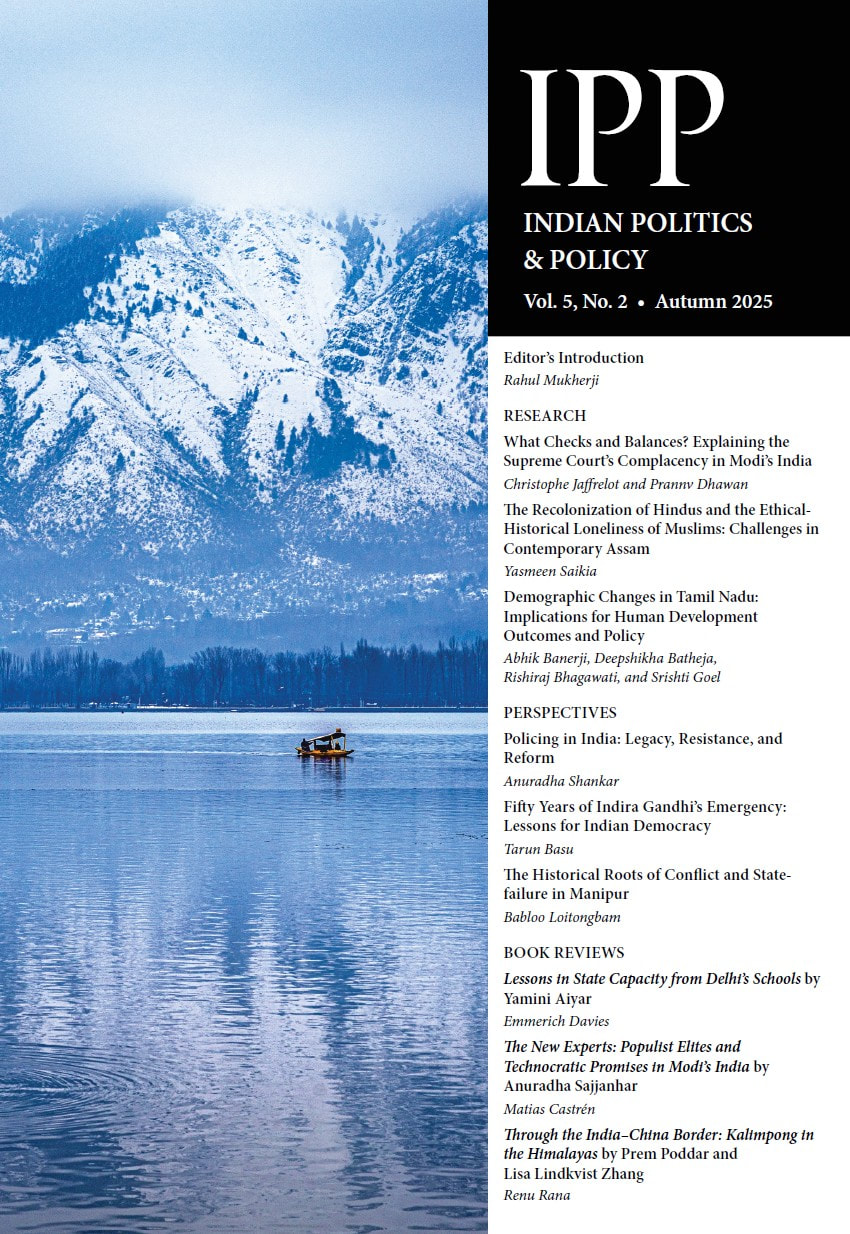
CSH Visiting researcher Prannv Dhawan has co-authored an article with Christophe Jaffrelot titled “What Checks and Balances? Explaining the Supreme Court’s Complacency in Modi’s India.” Published in Indian Politics & Policy, Vol. 5, No. 2, Autumn 2025.
The full article is available here.
Abstract: Across many democracies experiencing institutional decline, the judiciary has often been a primary target. While some courts have resisted authoritarian pressures, others have enabled them. Typically, a judiciary’s ability to resist depends on its structural independence and the institutional safeguards surrounding it. The Supreme Court of India presents a puzzling case. Despite formal independence—particularly in judicial appointments—it has failed to uphold the rule of law during the Modi government’s tenure. This paper examines the role of the Supreme Court in India’s democratic backsliding from 2014 to 2025. Through a close study of the tenure of all Chief Justices during this period, we trace the erosion of judicial autonomy. We highlight patterns of executive influence, ideological convergence between the judiciary and the government, and inconsistent jurisprudence on fundamental rights. Special attention is given to the longest-serving Chief Justice, whose mixed doctrinal and public positions reveal deeper structural ten-
sions within the Court. We also examine the crucial judicial opinions authored by judges appointed in this period, offering insight into how courts have aided consolidation of authoritarian politics. This analysis contributes to a broader understanding of how courts may become complicit in democratic decline, even when formal independence remains intact.


